

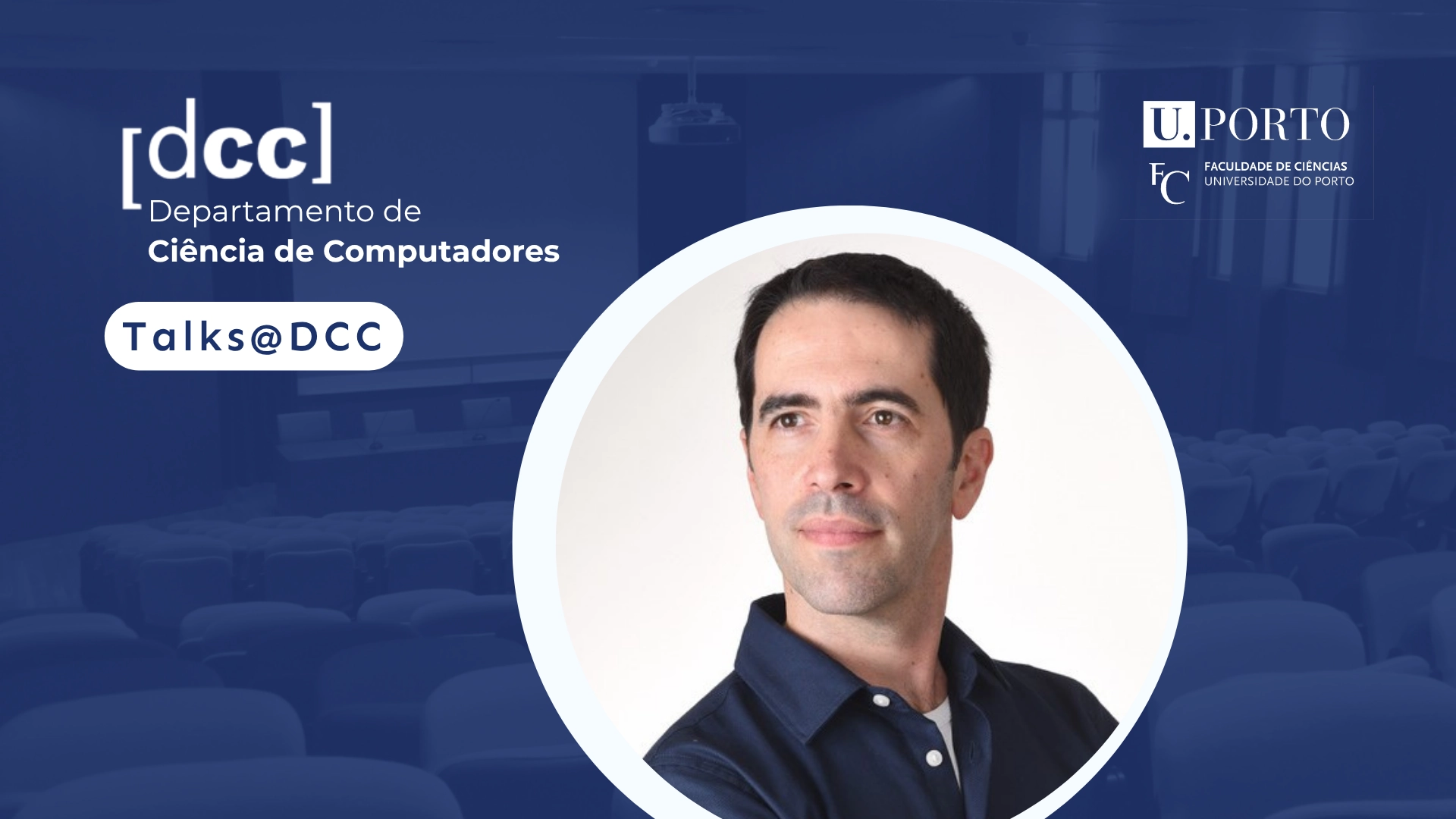
By José Proença
On 26 June at 2 pm, in FC6 0.29, José Proença will give a lecture entitled "Asynchronous Team Automata".
Title:
Asynchronous Team Automata
Abstract:
Team automata were introduced as a flexible extension of I/O automata to model collaborative behaviour in component-based and distributed systems. Their distinctive features include multi-party communication and a liberal synchronisation mechanism: components may jointly execute shared actions according to synchronisation policies that specify which subsets of components participate as senders or receivers. While this makes team automata well suited for modelling coordination, existing communication is synchronous and therefore insufficient for capturing certain behavioural aspects (e.g., due to message reordering) of modern networks and distributed systems, in which communication is typically asynchronous and message delays are unpredictable. In this paper, we introduce asynchronous team automata (ATeams), which extend team automata with buffers to model asynchronous communication, in addition to conventional synchronous interaction. ATeams support individual interactions involving multiple senders and receivers, unlike well-known asynchronous models such as communicating finite-state machines and multi-party session types. We formalise the syntax and operational semantics of ATeams, study well-formedness and well-behavedness conditions, and present the prototypical A-Team tool that supports specification, animation and automated checks. This proposes ATeams as a unifying semantic foundation for modelling and analysis of heterogeneous synchronous-asynchronous multi-party interactions.
Bio:
José Proença is an Assistant Professor at FCUP, Researcher at CISTER, and an external collaborator of INESC TEC, Portugal, working on formal models for component-based systems. Until January 2019 he worked in HASLab, INESC TEC & University of Minho, mainly with Luís Barbosa, and was affiliated with Distrinet, KU Leuven, until January 2016, working mainly with Danny Hughes and Dave Clarke. His work has been mainly on coordination of distributed components, often associated to the Reo coordination language, and on formal approaches to software product line engineering. More recently he has been working on choreographic languages with multiparty interactions and on programs with differential equations describing continuous behaviour. Before he graduated in University of Minho, Portugal, for a 5 year degree in Mathematics and Computer Science. He studied abroad for 6 months as an Erasmus student in Bristol University, UK. He defended his PhD in Leiden University in May 2011, for his work carried in CWI, Amsterdam, in the group for Foundations of Software Engineering.